
Digital Business Cards for Consulting Firms | Easy Consultation Booking
It is impossible to imagine modern business without consultants, whose knowledge and experience help companies grow steadily. At the same time, the high demand for such services intensifies competition. And the ability to attract clients and enforce an effective process for handling bookings has become a key factor in success.
Digital business cards excel at this task, helping professionals optimize their work – from securely managing client data to exchanging professional contact information and ensuring convenient appointment booking via a calendar. With just a few taps, potential clients receive all the essential information, including service offerings, experience, and the option to schedule a consultation.
Lengthy email exchanges become unnecessary, reducing the risk of missed opportunities, while the journey from initial interest to confirmed booking takes only seconds. When implemented effectively, a digital business card becomes more than a contact tool – it turns into a streamlined entry point for new clients and a practical driver of conversions.
Contents:
- Digital Business Cards with Consultation Booking for Consultants
- Optimization Guide: Best Practices for Your Digital Business Card for Consultants
- Secure Digital Business Card Solutions: Top-Tier Protection for Consulting Firms
- Comparing Booking Accessibility and Integration Tools
- Frequently Asked Questions
Digital Business Cards with Consultation Booking for Consultants
Digital business cards have become the standard for modern companies. This comprehensive solution combines a professional image with a convenient meeting scheduling tool. With them, you can securely share contact information, showcase your services, and sync your calendar – all within a single, user-friendly interface.
Naturally, this significantly boosts conversion rates right from the first interaction. But it wasn’t always this way, and many specialists are probably familiar with the situation in which they had a great conversation with a potential client at a conference or networking event and were certain they would definitely call back, yet without effective digital networking, that initial momentum often fades.
But sometimes a physical paper business card gets left behind in a desk drawer or even accidentally ends up in the laundry. In short, it doesn’t matter – the opportunity is lost anyway. This is the reality that’s pushing consultants toward a smarter way of making connections. Digital business cards with built-in consultation booking aren’t just a tech upgrade.
They’re a fundamental shift in how consulting professionals turn handshakes into signed contracts. And the numbers back it up. The global digital business card market was valued at approximately $215 million in 2025 and is projected to excefed $680 million by 2035. This isn’t a passing fad. That’s a market responding to a genuine need – especially in consulting, where 60% of initial clients come from referrals, and the speed of follow-up can make or break a deal.
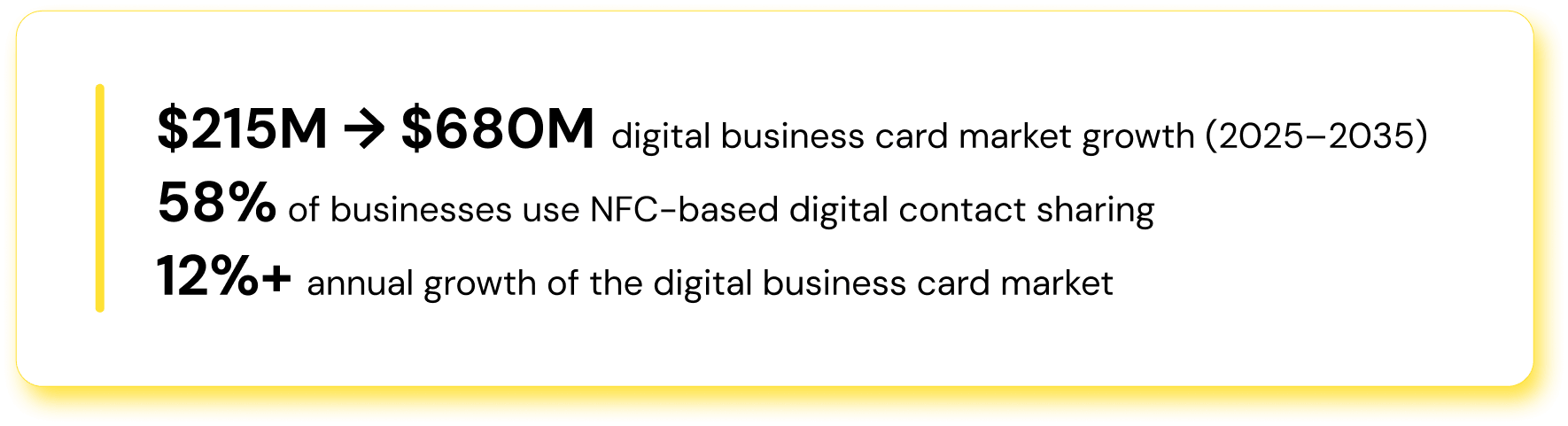
Against this backdrop, the shift toward digital business cards isn’t slowing down. With approximately 58% of businesses in developed economies already adopting NFC-based contact sharing, and the broader digital business card market growing at over 12% annually, this is quickly becoming a new standard. For consultants specifically, the integration of booking functionality is the game-changer.
It transforms a passive networking tool into an active business development asset. Every card you share becomes a potential consultation. Every interaction becomes a potential client. The technology is already mature, the platforms are affordable, and the setup is straightforward.
In practice, the only thing standing between most consultants and a more effective networking strategy is the decision to make the switch. So let’s dig into why this matters for your practice, how to customize it right, and what separates a premium digital card from one that actually books meetings.
Strategic Advantage: Why Every Digital Business Card for Consultants Must Have Booking
What do you think is the key feature of consulting? People who aren’t familiar with this field don’t even realize that the deal isn’t sealed in the conference room. The technical details come later, but it actually starts in the hallway. For example, at a dinner. During a casual introduction at a networking event.
The consultant who can move that initial spark of interest into a scheduled conversation, quickly and seamlessly, wins the engagement. That’s exactly what a digital business card with consultation booking does. It collapses the gap between “nice to meet you” and “let’s talk next Tuesday at 2 PM.”
Streamlining the Connection for Modern Consulting Firms
Think about the traditional path from first contact to a booked consultation. Someone gets your card. Maybe they email you a few days later. You respond. They suggest a time. You’re always busy, and by the time you finally get around to making the call, the urgency has already gone. The prospect has cooled off. Maybe they’ve already talked to another consultant who was faster.
Digital business cards can solve the issue with all those friction points. When you share your card, whether through a QR code at a conference, an NFC tap at a client meeting, or a link in your email signature, the recipient doesn’t just see your name and phone number. They see a “Book a Consultation” button. One tap, and they’re looking at your real-time availability. They pick a slot. Done.
No email chains. No phone tag. No lost momentum. For consulting firms managing multiple partners and associates, this is even more powerful. Each team member carries a digital card that routes bookings to the right person’s calendar. The firm captures the lead instantly, and the CRM is automatically updated. It’s a pipeline that runs itself.
But the ROI goes beyond direct bookings. There’s the time saved on manual data entry – industry estimates suggest that people spend an average of 5-10 minutes per contact manually entering information from paper cards. Multiply that by the dozens or hundreds of contacts you make at a busy conference, and you’re looking at hours of administrative work eliminated.
According to consulting industry research, 42% of consultants struggle to convert prospective buyers into clients. That’s not usually a quality problem – it’s a speed and convenience problem. The easier you make it for clients to take the next step, the more likely they are to take it.
Now consider the cost of a digital business card platform. Most range from $5 to $15 per user per month for professional plans. Even at the high end, that’s $180 per year per consultant. The math is pretty straightforward. If your digital card helps you book even one additional consultation that converts into a client, you’ve paid for the platform many times over.
Digital Business Cards for Consulting Firms: Beyond Simple Contact Details
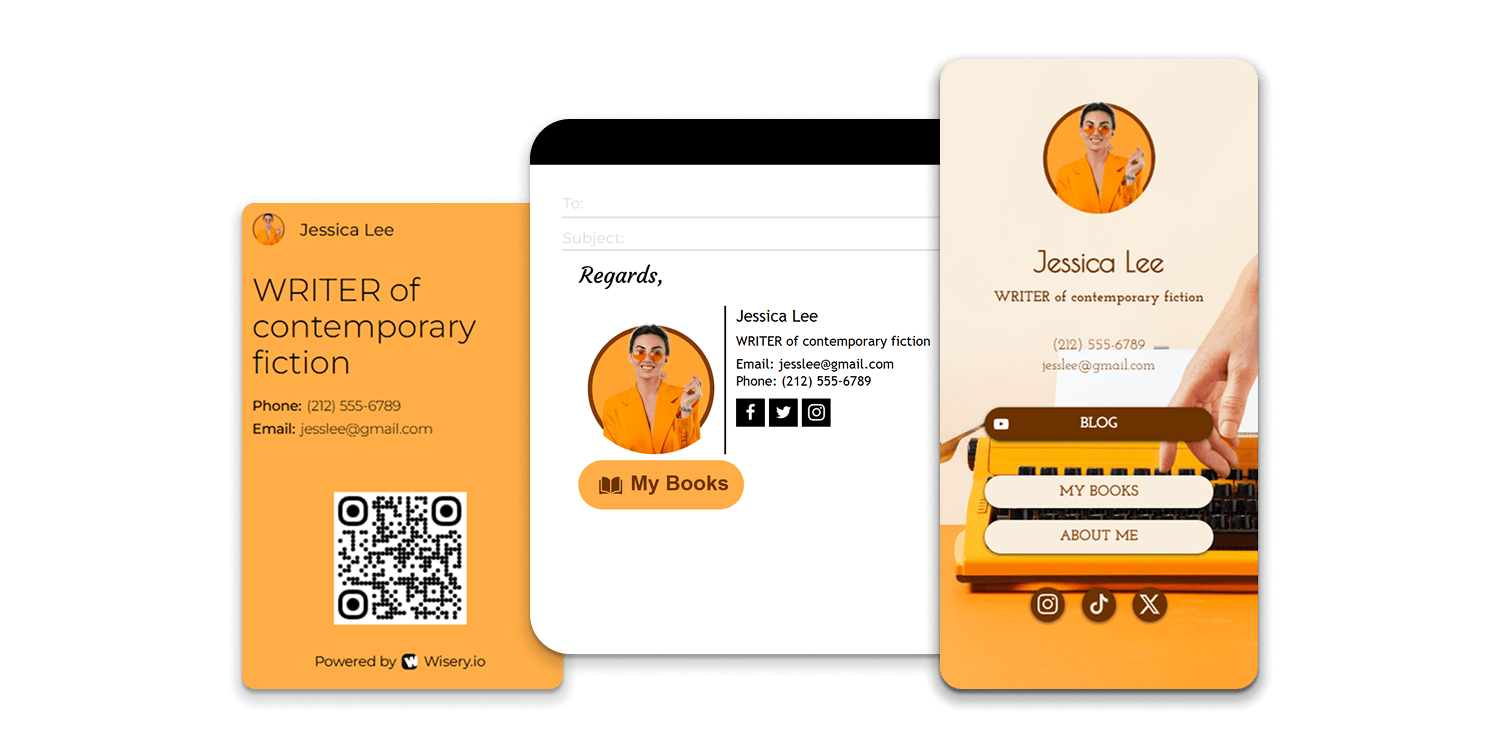
First and foremost, it’s worth noting that a digital business card is not just a PDF version of a traditional business card. It’s a digital version that doesn’t get lost and is always at your fingertips. A well-designed digital business card for consultants is an effective lead-capture tool. Every element in your digital business card info should serve a purpose.
Your headshot builds trust. Your value proposition tells them why they should care. Your credentials establish authority. And your booking link converts interest into action. Think of it as a micro-landing page that lives in someone’s phone. The best digital cards for consulting professionals include:
- A clear value proposition: experience and knowledge, which help the clients achieve their business goals.
- Key qualifications and certifications: factors that build trust in your field.
- Social proof: a brief client testimonial or notable project reference.
- Direct booking integration connected to your actual calendar, not a generic contact form.
- Links to relevant content: case studies, thought leadership articles, or LinkedIn profile.
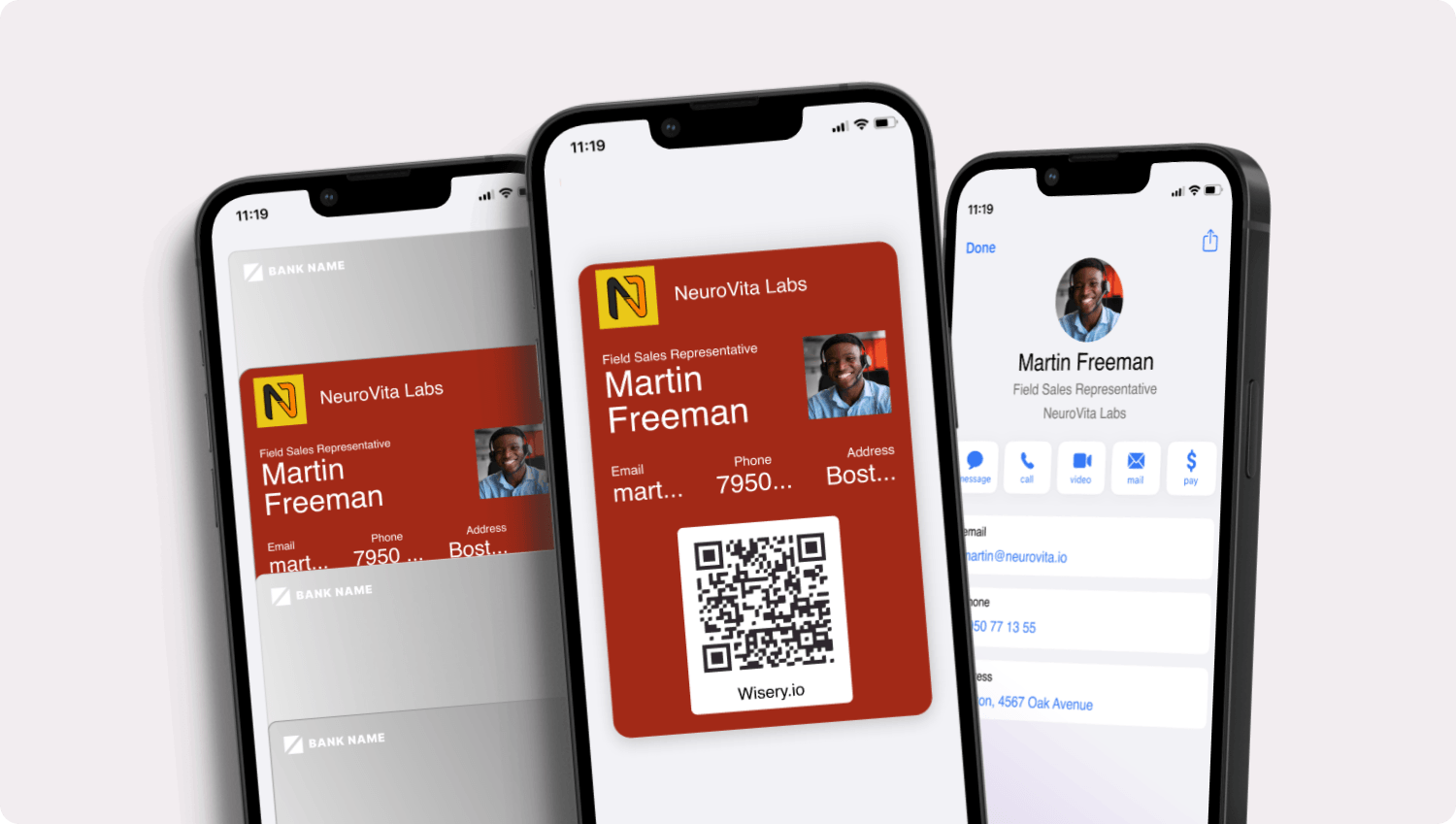
When a prospect receives this kind of card, they’re not just getting your contact details. They’re getting a complete picture of who you are, why you’re credible, and how to hire you – all in about 30 seconds. That’s the difference between a digital card that sits in someone’s contacts and one that actually generates revenue.
Optimization Guide: Best Practices for Your Digital Business Card for Consultants
Getting a digital business card is the easy part. Making it work hard for your consulting practice? That takes some thought. Here’s what separates the cards that collect dust from the ones that fill your calendar. And the point here isn’t whether you have the right tool, but whether you know how to use it strategically.
High-Value Information Detail for Consulting Firms
The biggest mistake consultants make with their digital cards is treating them like a traditional business card: name, title, phone, email, done. That’s a wasted opportunity. Your digital card has room for so much more, and every piece of information should be chosen strategically.
✔ Start with your headline. If you limit yourself to a headline like “Management Consultant,” it’s unlikely to capture your target audience’s interest, since it provides absolutely no details. It’s a completely different story if it reads something like “Assisting B2B startups in growing their revenue from $1 million to $10 million” That’s specific and memorable. Moreover, it tells a prospect immediately whether you’re the right fit.
✔ Ensure integration with a calendar. You can connect the calendar to your favorite scheduling tool, such as Microsoft Bookings, or to your platform’s built-in scheduler. Be sure to verify that the tool displays real-time availability. Nothing frustrates users more than a link leading to a form that says, “I’ll get back to you later.”
✔ List the range of services you offer. You don’t have to list everything – it’s important to at least mention the main ones. If your specialization is tax and accounting, make sure to mention that. If you excel in both strategic consulting and practical implementation, clients should know that too. The better your audience understands your area of expertise, the more likely they are to use your services.
✔ Add a brief bio or video presentation. This is a great opportunity to stand out from the competition. Simply introduce yourself and explain exactly how you help clients – it will take no more than a minute, but the impact will be much more impressive. A video helps build trust even before a meeting. After all, people trust other people more than they do a pretty picture.
✔ Include your contact information. It’s important to make it as easy as possible for potential clients to reach you, so be sure to include your phone number, email address, current office address, and LinkedIn profile.
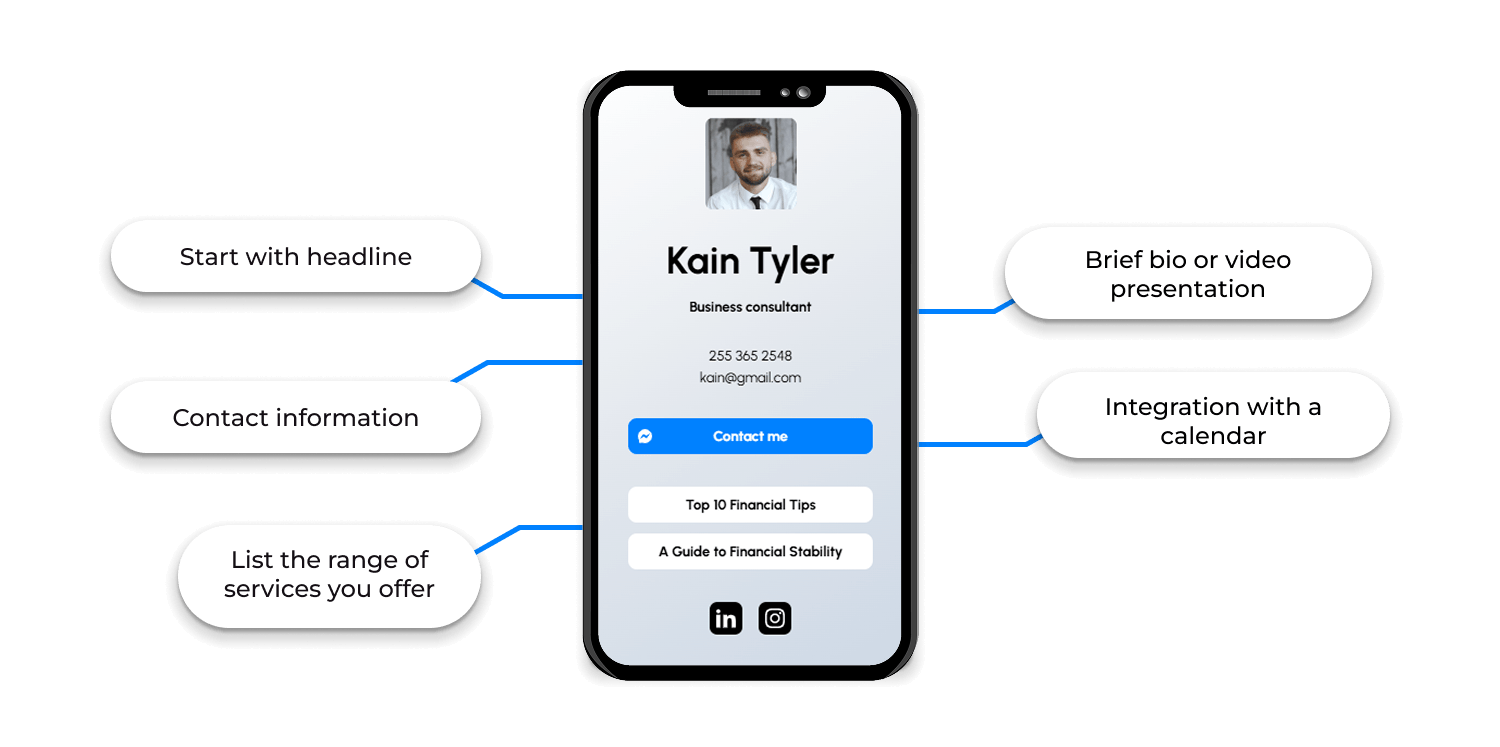
By combining all of the above recommendations, a digital business card becomes one of the most effective tools for attracting an audience. It not only introduces you but also clearly demonstrates your value and encourages people to take the next step – booking a consultation.
Trust Factors: Credentials and Expertise Showcase
In consulting, credibility is currency. A digital business card is often the first point of contact with your professional reputation, so it’s important that this first impression works in your favor right away. Sometimes, even a small detail can determine whether a potential client stays with you or chooses another professional. We recommend following these proven tips:
➤ Professional certifications displayed prominently. Whether it’s a PMP, CFA, Six Sigma Black Belt, or any other industry-recognized certification, it’s important that it stands out. These credentials clearly demonstrate that you’ve invested in developing your expertise and that your skills have been validated by independent organizations.
➤ Notable client logos or project references. You don’t need to name every client (and NDAs may prevent it), but even a line like “Trusted by Fortune 500 companies in the financial services sector” carries weight. If you can include specific logos with permission, even better.
➤ Published work and thought leadership. Links to articles, podcasts, or presentations. This type of content helps establish you as an expert who shapes the agenda in your field.
➤ Client testimonials. Even a single strong quote from a satisfied client can make all the difference. For example: “With [Name], we revised our go-to-market strategy and increased our order backlog by $3 million in just six months.” This sounds concrete and builds trust.
➤ Membership in industry organizations. Belonging to recognized professional organizations, whether the Institute of Management Consultants or a specialized industry association, adds another layer of legitimacy.
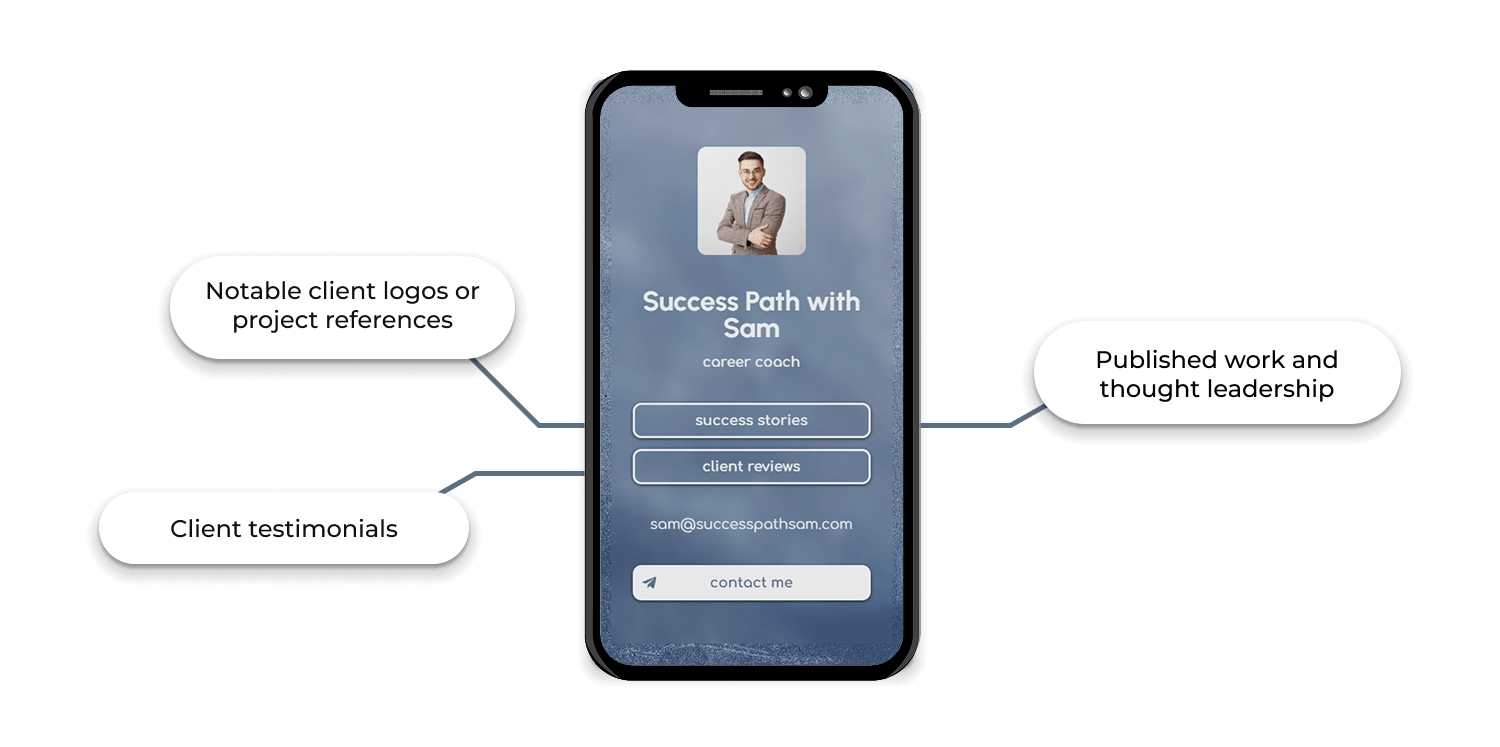
The goal isn’t to overwhelm the person with information, but to provide enough of it so they think: “This person knows what they’re doing. I should set up a meeting.” It is precisely this sense of confidence that becomes the primary trigger, turning interest into real action of booking a consultation.
Secure Digital Business Card Solutions: Top-Tier Protection for Consulting Firms
Security isn’t a nice-to-have in consulting. It’s a requirement. Your clients trust you with sensitive business information, and that trust extends to every tool you use, including how you share your own contact details. This is an area where digital business cards actually outperform their paper counterparts, but only if you choose the right platform.
Safeguarding Contact Details and Customer Privacy
When a prospect shares their information through your digital card’s booking form, that data needs to be protected. We’re talking about names, email addresses, phone numbers, and company details – all of which are personally identifiable information (PII) that falls under data protection regulations. A reliable platform for creating digital business cards guarantees:
- End-to-end encryption of all data transmitted between the business card and the platform’s servers.
- Secure cloud storage with regular backups and redundancy.
- Access controls so that only authorized team members can view contact data.
- Data retention policies that align with your firm’s compliance requirements.
- The ability to revoke access to a card if a team member leaves the firm.
For consulting teams that work with enterprise clients, these aren’t optional features but table stakes. Your client’s IT department may ask how you handle data, and using a secure platform for exchanging digital business cards will likely satisfy everyone. More importantly, it builds trust right from the very first point of interaction, long before any deal is signed.
A Thought-Out Approach to Data and Security Standards
In today’s business environment, the role of consulting firms cannot be overstated. They provide critical support to businesses in making strategic decisions, help optimize processes, and minimize risks. Therefore, compliance with regulatory requirements is a crucial factor for such firms, as it directly impacts their effectiveness and reliability.
For clients, this serves as proof of a serious commitment to data protection. And one of the most popular and recognized data protection frameworks is the GDPR. The General Data Protection Regulation consists of 99 articles that guarantee the protection of EU citizens’ data and are intended for companies and organizations that collect and process personal information.
International consulting teams must comply with GDPR requirements and have clear mechanisms for obtaining consent to collect data, a right for customers to request the deletion of their info, a transparent data processing policy, and robust procedures for reporting data breaches.
Also worth mentioning are voluntary standards such as SOC 2, which nonetheless remains one of the most widely recognized audit standards in the world. It evaluates a company’s processes based on the criteria of security, availability, processing integrity, confidentiality, and privacy protection.
Despite its voluntary nature, compliance with the SOC 2 standard is, in most cases, mandatory for corporate clients. A SOC 2 Type II report demonstrates that an independent auditor has reviewed the platform’s security measures over an extended period. For consulting firms, this matters at the sales level as well.
When a potential client inquires about the tools used and their security, they expect concrete details in response – specifically, that your digital business card platform complies with GDPR requirements and has passed SOC 2 audits. Why is this so important? Secure platforms simplify the implementation of policies across the entire company.
The information displayed on business cards, the employees who have access to the database, and the retention period for outdated data – all of these can be managed by the admin through centralized control. This is particularly important for large consulting firms. Without it, you’re simply leaving things to chance.
If we think back to traditional business cards, they obviously lack encryption, access controls, an audit trail, and the ability to revoke information after it has been shared. There’s the environmental angle, too. The consulting industry is increasingly expected to walk the talk on sustainability. NFC-enabled cards alone reduce physical waste by 92% compared to traditional paper cards.
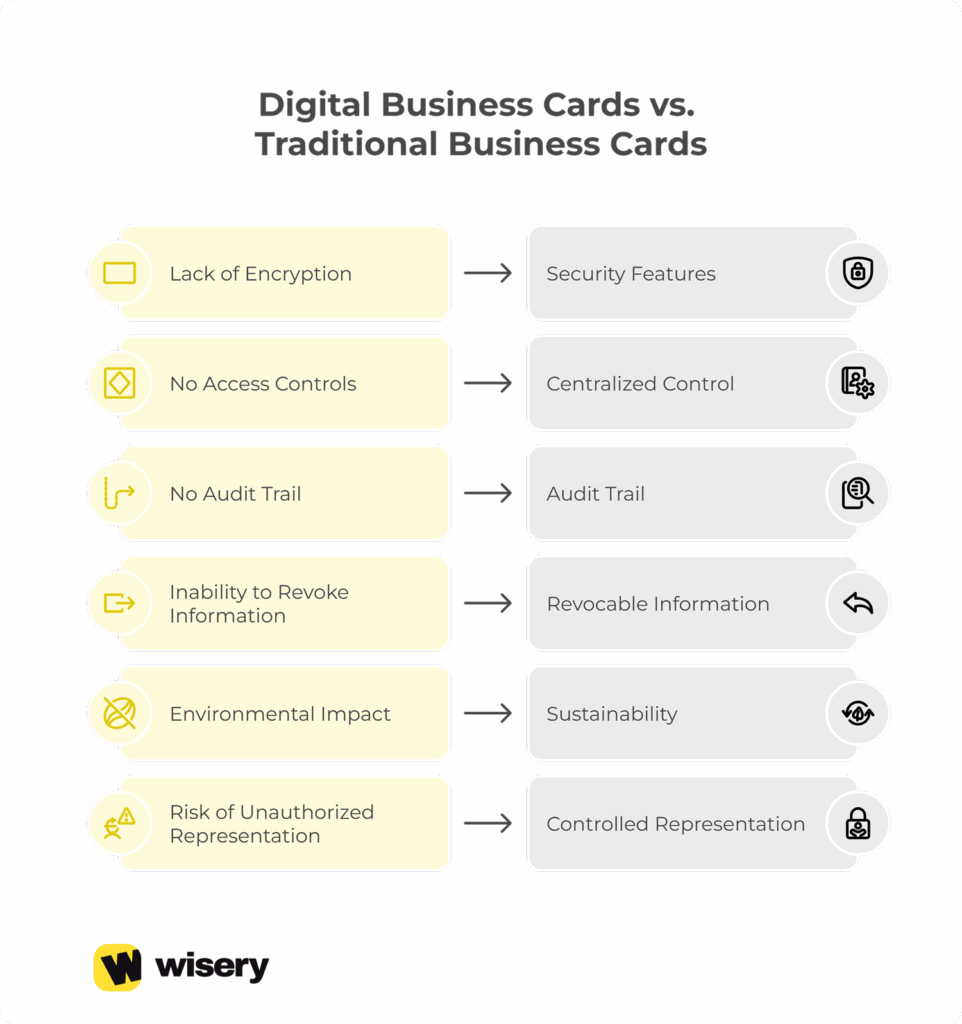
In other words, if a partner leaves your company and takes a stack of your business cards with them, they can continue to represent your brand whether you like it or not. With a digital card, you deactivate their profile with one click, and every card they ever shared now redirects to an updated page – or goes dark entirely. That level of control simply doesn’t exist in the analog world.
For consultants who advise clients on risk management, digital transformation, or regulatory compliance, using a secure digital business card isn’t just good practice – it’s practicing what you preach. It signals that your firm applies the same standards to its own operations that it recommends to clients. And in a trust-driven business like consulting, that kind of consistency matters more than most people realize.
Comparing Booking Accessibility and Integration Tools
Not all digital business card platforms offer the same booking and integration capabilities, and for consultants, the differences matter. A platform that looks great but doesn’t connect to your CRM, your calendar, or your marketing automation tools creates more work than it saves. The whole point is to reduce friction – not to add another disconnected tool to your already crowded tech stack. Here’s what to evaluate when comparing platforms:
❖ Calendar integration depth. The minimum standard is a link to your Calendly or Google Calendar page. But the best platforms go further, embedding the calendar directly into the card experience so the prospect never leaves the interface. Wisery uses exactly this approach. Customers can view available time slots and book services without opening a separate app or browser tab. The fewer steps there are between interest and action, the higher your conversion rate will be.
❖ CRM integration is the second priority. When booking a consultation via a business card, the user’s information should be automatically imported into the CRM system. This way, you’ll never miss a thing. Some platforms even support custom fields, allowing you to collect information such as company size, industry, or the type of consultation the client is interested in.
❖ Support for NFC and QR codes offers excellent flexibility. NFC allows you to share a card simply by tapping a smartphone or a physical NFC-enabled card against another person’s device. QR codes work everywhere – they can be easily scanned using a device’s camera. The best approach, according to industry data, is to use both: NFC for speed and QR for universal compatibility.
❖ Team management features are essential for business leaders. In this case, it’s worth considering platforms that allow you to create professional business cards for all employees and manage them from a single dashboard. It is worth paying attention to factors such as ensuring brand consistency, controlling information (what team members can edit), and deactivating business cards for former employees.
❖ Analytics and tracking will help you understand what works. Which team members’ business cards generate the most bookings? Which events produce the best leads? How many people view your card versus how many actually book? This data is a real treasure trove for refining your outreach strategy.
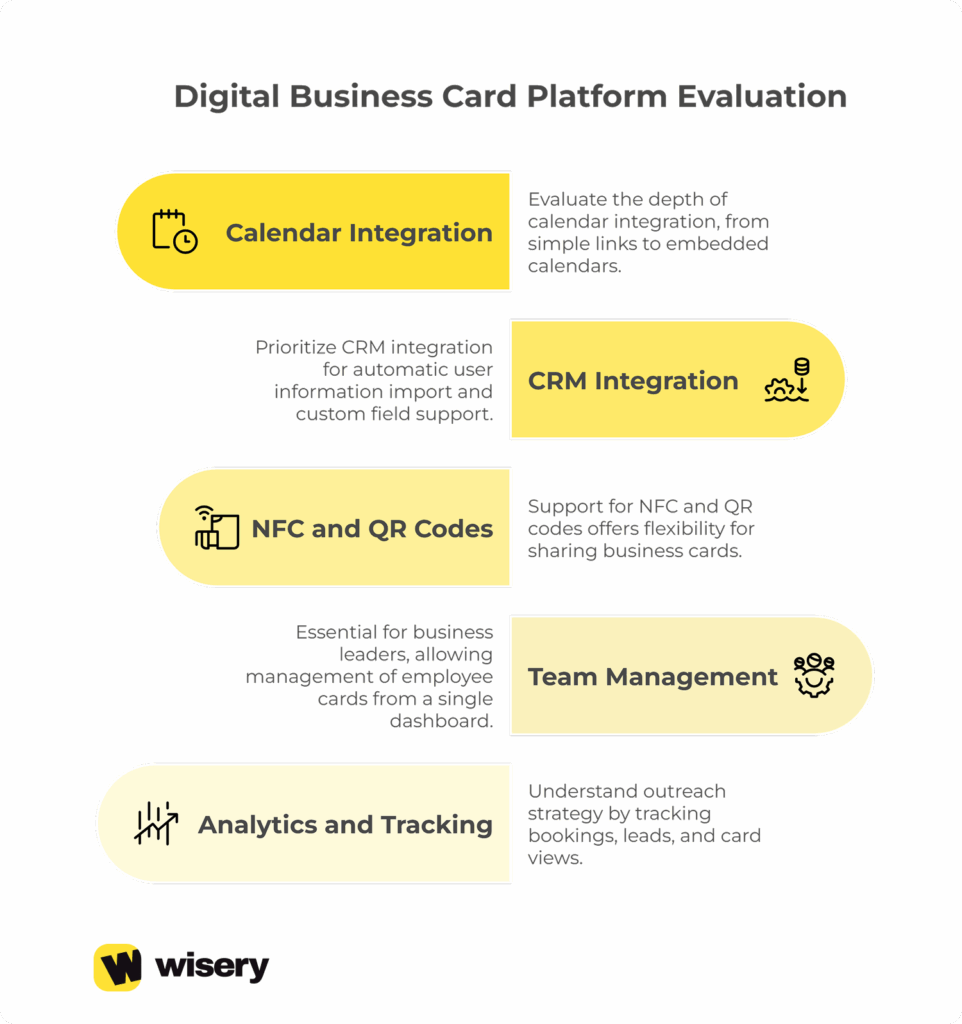
Below is a quick comparison of what to keep in mind on different platforms:
| Feature | Must-Have | Nice-to-Have |
| Calendar booking integration | ✅ | — |
| CRM sync (Salesforce, HubSpot) | ✅ | — |
| NFC + QR code sharing | ✅ | — |
| Team management dashboard | ✅ (for firms) | ✅ (for solos) |
| Custom branding | ✅ | — |
| Analytics & engagement tracking | ✅ | — |
| Video introduction support | — | ✅ |
| Lead capture forms | ✅ | — |
| GDPR/SOC 2 compliance | ✅ | — |
| Email signature integration | — | ✅ |
| Offline functionality | — | ✅ |
Platforms like Wisery, Blinq, Mobilo, and HiHello offer a host of advantages. Wisery, for example, perfectly combines a professional image with the ability to make instant bookings – a feature appreciated by enterprising consultants who aim to turn every interaction into a potential consultation. Blinq offers strong team management features. Mobilo is chosen for its physical NFC cards. HiHello’s sleek and user-friendly interface also finds its audience.
A wide selection serves as yet another advantage. Each tool is designed for consultants with different needs. For example, if you work independently, choose platforms with a simple interface and integrated booking functionality. Medium-sized companies should consider tools with team management features and CRM system integration.
As you can see, choosing the right tool isn’t difficult. If you want to turn new contacts into customers, pay special attention to the booking feature. It should be prominently displayed on the business card interface. No one wants to scroll through pages of information just to find the booking button. That’s why the booking button should be clearly visible and easy to access.
Frequently Asked Questions
How can I use a digital business card to get more consultation bookings?
To capture leads, consider a few things. First, choose a platform that integrates with your calendar. Next, set specific time slots for consultations and place a booking link in a prominent spot on your digital business card. Finally, whenever you meet with clients, no matter where, all you have to do is share your business card.
This way, you give people the opportunity to book a consultation as quickly as possible. You can also add a link to your business card in your email signature and LinkedIn profile to attract even more clients. And most importantly, make the booking process as easy as possible. Simplicity is the key to success, and this rule works most effectively here.
What information should a consultant put on a digital business card to stand out?
Consultants who need to stand out from the competition should pay special attention to the headline, since that’s the first thing people notice. Think about it: would a phrase like “Senior Consultant” catch your attention? Probably not. But a headline like “I help companies enter new markets in 3–6 months” sounds much more compelling.
It immediately demonstrates value rather than simply stating a job title. A professional photo, key achievements, and certifications also work in your favor, building trust and setting you apart from other professionals. Enhance your profile with client testimonials, results from significant projects, or logos from well-known companies.
Add a link to your LinkedIn profile and materials that confirm your expertise. And be sure to include a prominent “Book a Consultation” button. It’s important to provide enough information to build trust, but don’t overload the page – too many extra details can backfire.
Are digital business card solutions secure enough for high-level consulting?
Yes, provided you use a reliable platform with a robust data protection system. Only this will ensure long-term value. Look for end-to-end encryption, SOC 2 compliance, and data processing in accordance with GDPR requirements. High-quality solutions also offer flexible access settings, data retention policies, and the ability to quickly revoke access to cards if an employee leaves the company. In many ways, digital business cards are actually more secure than paper cards.
Paper cards can be lost, copied, or seen by unintended parties. A digital card on a secure platform gives you control over who sees your information and how contact data is stored and managed. For consultants working with enterprise clients or in regulated industries like healthcare and finance, security certifications from your card platform can be an important part of your vendor compliance documentation.
The consulting industry is built on relationships. But relationships start with connections – and connections start with how you introduce yourself. A digital business card with integrated consultation booking isn’t just a modern convenience. It’s a competitive advantage that turns every interaction into an opportunity. The question isn’t whether you should make the switch. It’s how soon you can start.