Professional Credentials on Business Cards: Quick Summary
Use only credentials that support your current role and audience. A practical order is:
- Highest relevant academic degree
- Professional license or designation
- Recognized industry certification
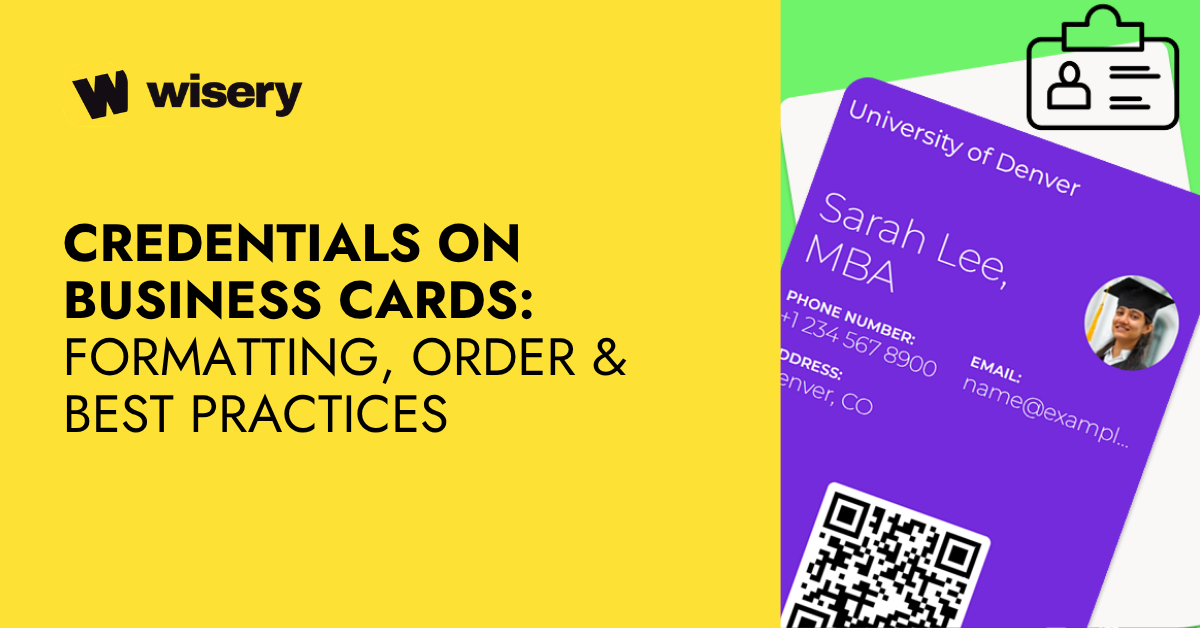
For example: Sarah Lee, MBA, PMP.
Use commas between credentials, follow the official abbreviation provided by the issuing organization, and usually limit the list to one to three credentials. Digital business cards can also help reduce common issues with paper cards, such as outdated certifications and limited options for linking to verification sources.
Purpose of Listing Credentials on a Business Card
A business card is more than a way to share your email address or phone number. It can quickly show that you have relevant education, licensing, or specialized training.

Credentials can be especially useful when clients need reassurance before choosing a professional service provider. A CPA may signal accounting expertise, a PMP may be relevant for project management work, and a PE designation may matter to engineering clients.
The goal is not to list every achievement. It is to give the recipient a clear, credible reason to remember what you do.
Building Authority and Trust
People often look at a business card for only a few seconds. A relevant credential can help them understand your expertise without needing a longer explanation.
For example, “John Davis, CPA” immediately communicates more about an accountant’s professional background than “John Davis, Accountant.” The same applies to credentials such as PMP, CFP, PE, or CISSP when they are directly related to the service being offered.
Credentials are most effective when they are:
- Recognized in your industry
- Relevant to the recipient
- Current and accurately displayed
- Used in their official format
Industry Compliance and Legal Requirements
In some regulated professions and jurisdictions, license numbers, titles, or disclosures may be required on business cards and other marketing materials. These rules can vary by profession, country, state, or licensing authority.
Before printing a card, check the current requirements that apply to your role. This is particularly important for regulated fields such as real estate, law, healthcare, engineering, accounting, and financial services.
Even where a credential is not legally required, it may still be a professional expectation. Use your judgment and prioritize what is useful for your audience.
How to Correctly Format Credentials After Your Name
There is no single universal rule for every profession. However, a common and practical sequence is:
- Highest relevant academic degree
- Professional license or designation
- State or regional designation, where applicable
- National or industry certification
Always follow the naming and abbreviation rules of the issuing institution or professional organization.
The Standard Sequence: Academic vs. Professional Certifications
Start with the highest academic degree that is relevant to your work. In many cases, you do not need to list lower degrees once you have a higher one. For example, someone with an MBA usually does not need to include a BBA as well.
Next, add licenses or professional designations that are relevant to your role. After that, consider one or two recognized certifications that help clients understand your specialization.
Examples:
- Jennifer Walsh, PhD, CPA
- Michael Torres, JD, CFP
- Sarah Kim, MBA, PMP
Keep the final result easy to read. Your card should clarify your expertise, not become a condensed résumé.
Professional role | Better format | Avoid | Why |
Accountant | John Smith, CPA | John Smith, MBA, CPA, CFE, CISA | CPA is usually the most relevant credential for accounting clients. Too many credentials can make the card look cluttered. |
Project manager | Sarah Lee, PMP | Sarah Lee, MBA, PMP, Six Sigma, Agile Certified | PMP is clear and recognizable. Listing too many certifications can distract from the main qualification. |
Engineer | David Chen, PE | David Chen, P.E., Engineer Certified | PE is a recognized designation. Avoid unofficial or unclear wording. |
Consultant | Emma Brown, MBA | Emma Brown, BBA, MBA | The highest relevant degree is usually enough. Lower degrees do not need to be listed when a higher degree is included. |
Financial planner | Michael Torres, CFP | Michael Torres, CFP, Finance Expert | Official credentials are clearer and more credible than self-made titles. |
Punctuation and Spacing Standards
Use a comma between your name and each credential:
David Chen, PhD, PE
In most cases, modern abbreviations do not use periods:
- MBA, not M.B.A.
- CPA, not C.P.A.
- PMP, not P.M.P.
However, official formatting can vary. Always check how the degree-granting institution or certification body presents the credential.
Use one space after each comma and keep capitalization consistent.
✅ Correct: David Chen, PhD, PE
❌ Incorrect: David Chen,PhD,PE
❌ Incorrect: David Chen , PhD , PE
Listing Academic Degrees vs. Professional Certifications
Academic degrees show formal education. Professional licenses and certifications usually show specialized or regulated expertise.

The best choice depends on your role and your audience. An MBA may be useful for a consultant or corporate leader, while a CPA may matter more for an accountant. A PMP can be valuable for a project manager, while a portfolio may be more important for a designer or creative professional.
Ask one simple question: will this credential help the recipient understand why they should trust me for this specific work?
Should I Put My MBA on My Business Card?
Include an MBA when it is relevant to the work you do and meaningful to your audience. It can be useful for consultants, managers, business leaders, finance professionals, and people working in strategy-focused roles.
Leave it off when another credential is more relevant or when space is limited. For example, a CPA may be more useful than an MBA for tax clients, while a PE may be more relevant for engineering work.
Balancing Multiple Designations Without Clutter
A long list of credentials can reduce readability and weaken your main message.
❌ Too much:
Robert Martinez, MBA, PMP, CISSP, CFA, Six Sigma Black Belt, LEED AP
✅ Clearer:
Robert Martinez, PMP
Choose the credential that best matches the situation. You may even use different versions of your card for different audiences.
For example:
- Meeting project management clients: Robert Martinez, PMP
- Discussing business strategy: Robert Martinez, MBA
- Working with cybersecurity clients: Robert Martinez, CISSP
A good rule is to use no more than three credentials. One or two is often enough.
Common Mistakes When Putting Credentials on Business Cards
Avoid these common mistakes when designing your card:
❌ Using incorrect abbreviations. Always use the official abbreviation provided by the certifying organization.
❌ Listing unfinished credentials. Avoid phrases such as “MBA in progress” or “Preparing for CPA exams.” Business cards should reflect completed qualifications.
❌ Including irrelevant credentials. Focus on qualifications that support your current role and services.
❌ Using self-created titles. Vague labels such as “Finance Expert” or “Certified Business Leader” may look misleading if they are not official designations.
❌ Using logos without permission. Certification logos may be protected by trademark rules. Check the organization’s usage policy before adding one.
❌ Mixing honorary and earned credentials without clarification. If you include an honorary degree, make its status clear. In most cases, it is better suited to a full biography or CV than a business card.
Outdated Titles and Expired Licenses
Credentials can change over time. Licenses may expire, certifications may require renewal, and job titles or contact details can become outdated.
This creates a practical problem for paper business cards. If one detail changes, you may need to reprint the entire batch. Until then, old cards may contain information that is no longer accurate.
Digital business cards can make updates easier. Instead of replacing printed cards, you can update your profile and keep your current contact details, links, credentials, and role information in one place.
The Digital Shift: How to Add Credentials to a Digital Business Card
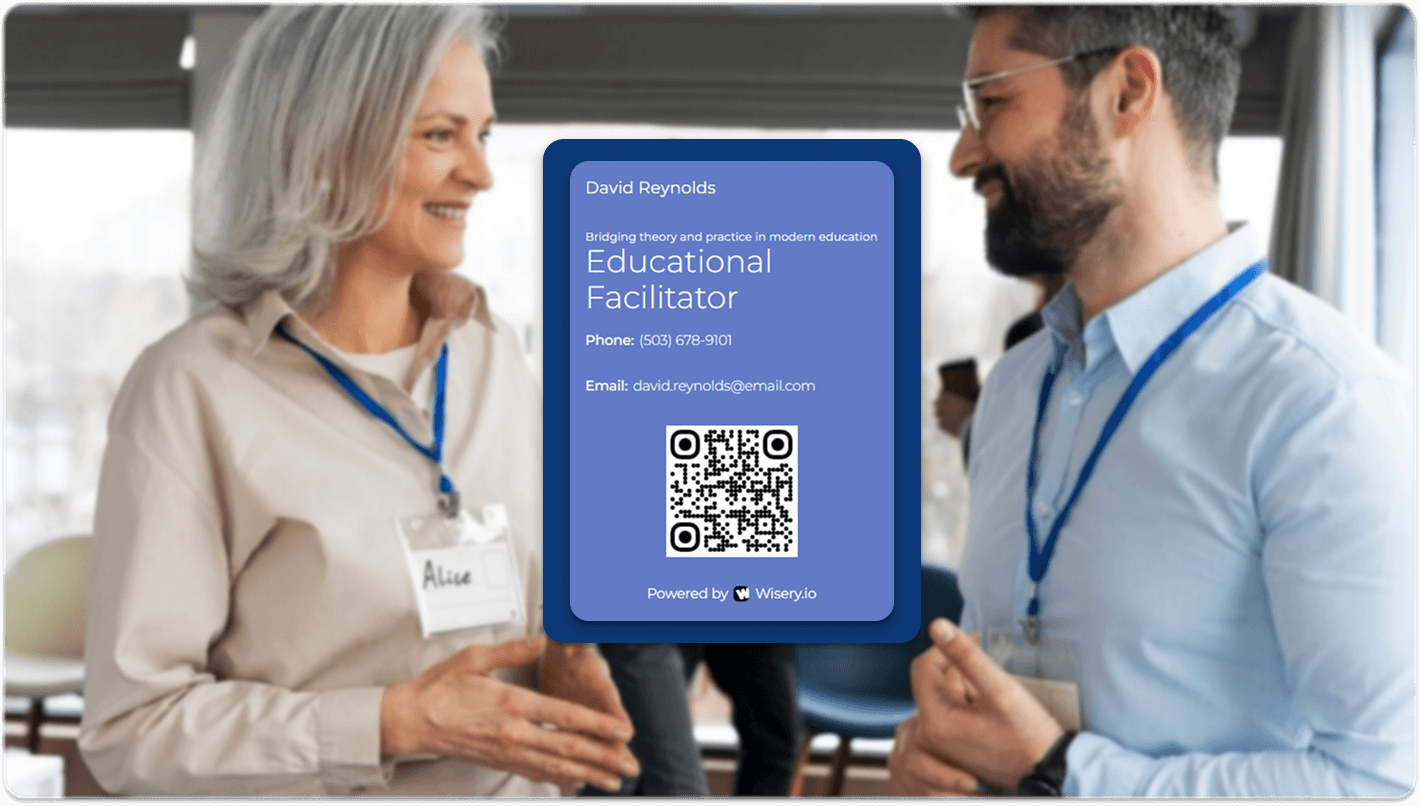
Digital business cards give professionals more flexibility than traditional printed cards. They can be shared through a QR code, NFC, or a quick link, and they can include more than basic contact details.
You can add a short credential list to the card itself and link to external pages where people can learn more. This may include your LinkedIn profile, professional portfolio, licensing directory, certification page, or digital badge.
Platforms like Wisery can make this easier by allowing professionals to keep their contact details current and link to external sources where credentials may be verified, such as LinkedIn profiles, licensing pages, or digital badges.
Linking to Verification Sources
A paper card can only display a limited amount of information. A digital card can direct people to sources that provide more context about your background.
For example, a financial planner could list “CFP” on the card and add a link to an official profile, certification source, or professional website. An engineer could link to a portfolio, licensing page, or LinkedIn profile.
This does not replace formal verification procedures where they are required. However, it can make it easier for prospects to find relevant information and better understand your qualifications.
Dynamic Updates for Changing Credentials
Professional information changes often. You may earn a new certification, move to another company, update your title, or need to remove an expired designation.
With paper cards, each change may require a new print run. With a digital card, you can update the information in your profile and share the current version through the same QR code or link.
This can help professionals reduce outdated information, avoid unnecessary reprinting, and keep their networking materials more accurate over time.
Frequently Asked Questions
What professional credentials should be on a business card?
Include the credentials most relevant to your current role and audience. Usually, this means your highest relevant degree, required license, and one recognized professional certification.
How should I handle credentials if I am currently pursuing a degree?
Do not list unfinished degrees or certifications on your business card. Add them only after you have officially completed the program or received confirmation from the issuing organization.
Should I include the institution’s name next to the degree?
Usually, no. The degree abbreviation is enough for a business card, while the institution name can be included on LinkedIn, your website, or an email signature.
Can I list honorary degrees alongside earned credentials?
You can, but honorary degrees should be clearly marked to avoid confusion. In most cases, earned credentials are more useful on a business card because they are easier for recipients to understand quickly.

About Author

Danylo is a marketing professional with a strong interest in developing effective, results-driven strategies for modern businesses. As a Marketing Manager at Wisery, he focuses on improving communication, strengthening brand presence, and optimizing digital channels such as email marketing and customer engagement. With a practical, hands-on approach, he is passionate about turning complex marketing concepts into clear, actionable insights that businesses can easily apply.